





AI has become scarily good at sounding right. Ask ChatGPT, Claude, or Gemini a complex question, and you'll get an answer with examples, analogies, and a confident, balanced tone. It feels authoritative. Complete. Final.
And that's exactly the problem! Its designed to make you feel satisfied, not informed.
Here’s the hidden truth: AI answers systematically skip over the edge cases, the contradictions, the deeper “what-ifs.” This isn't an accident; it's by design.
Most AI models are trained with something called Reinforcement Learning from Human Feedback (RLHF), which is basically a giant popularity contest for AI answers. Human raters vote on which answer they like best, and the AI learns to create answers that look like the winners.
Humans prefer confidence over honesty. " One study found that when an AI admits "I'm not sure," users rate it poorly—even when that uncertainty is the most accurate response.
So, the AI learns a simple lesson:
Always sound confident. Wrap everything up neatly. Give a feeling of closure
For simple homework or trivia, that's fine. But when you need the whole truth for deep research, this helpfulness becomes a hidden trap.
How to See What's Missing
So how do you fight an invisible problem?
This is why we built Critique in Mnemosphere. The process is deceptively simple:
- Ask your question and get a response from any AI model.
- Read the answer to get your baseline understanding.
- Then, simply click ‘Critique Response’ icon.
For even better results, you can ask one AI for the answer (like GPT-5) and a different AI (like Claude 4.5 Sonnet) to critique it. This is like getting a second opinion that helps you escape the first model's inherent biases.
Let's see the profound difference Critique makes with a real example.
The Prompt: "What is the best productivity method?"
We asked ChatGPT, and it gave the classic, perfect-sounding answer. It's helpful, well-structured, and covers the famous frameworks:
Summary of ChatGPT's Answer:
It feels comprehensive. It's actionable. You'd normally stop here, feeling fully informed and ready to try one of these methods.
But when you click ‘Critique’, you see what the AI left out.
| What the AI Didn't Tell You (Revealed by Critique) | Why It Fundamentally Changes Your Perspective |
|---|---|
⚠️ The Unmentioned Risk of "Productivity Theater"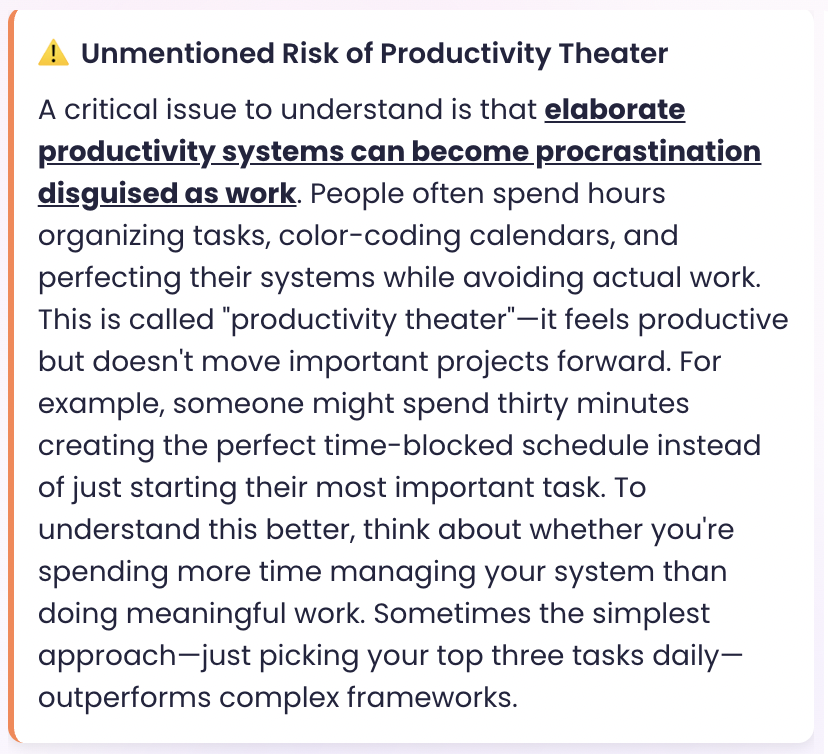
|
Critique points out that elaborate systems can become procrastination disguised as work. People spend hours organizing tasks and color-coding calendars while avoiding the actual hard work. It feels productive but achieves nothing. Without this insight, you might blame yourself for not being "disciplined enough" when the real problem is the system itself. |
🔄 The Overlooked Role of Personality Types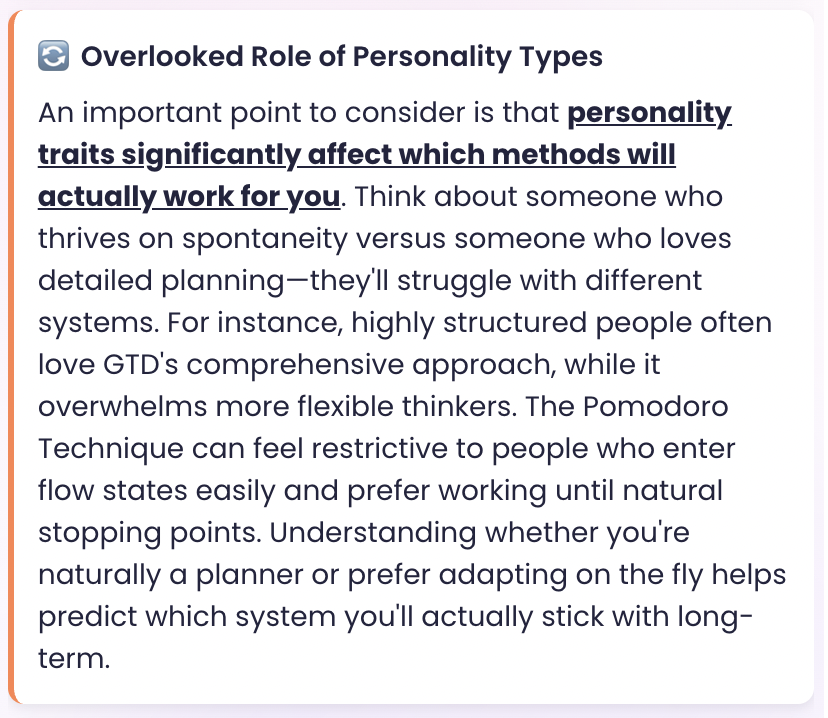
|
The AI treats these methods like one-size-fits-all tools. Critique reveals they clash with core personality traits. The rigid structure of GTD can crush a spontaneous, creative thinker, while the constant interruptions of Pomodoro can derail someone who achieves deep flow states. Without this, you'd waste months forcing a system that fights your natural thinking style. |
🔁 Unexplored Relationship Between Habits and Systems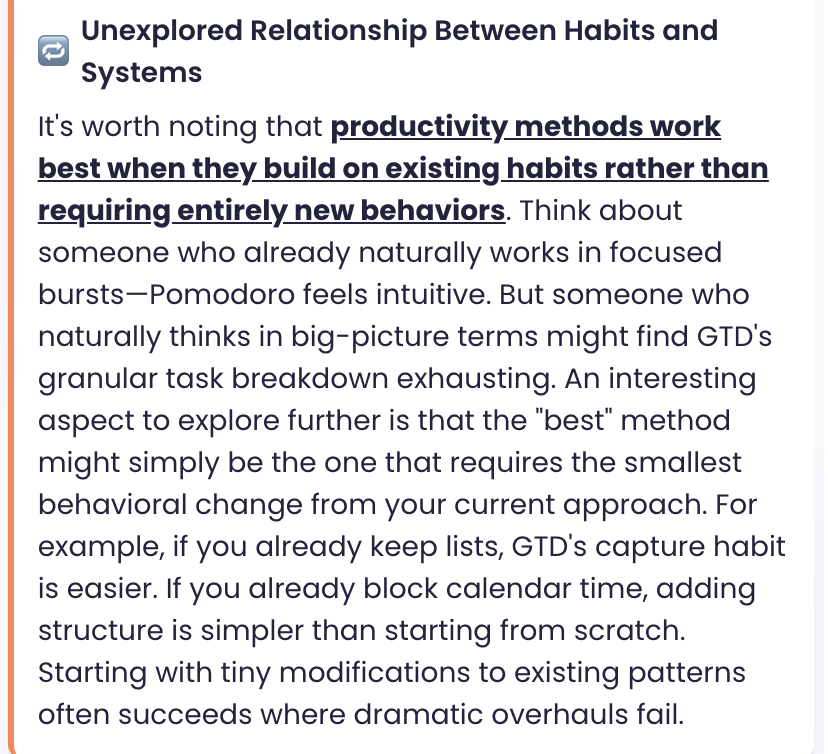
|
The AI suggests you should adopt a whole new system from scratch. Critique shows that it's smarter to build on habits you already have. Without this, you'd attempt a drastic overhaul, likely fail, and blame your willpower. This insight reframes the goal from 'total system replacement' to 'sustainable improvement,' dramatically increasing your chance of success. |
📱 Unexplored Impact of Digital Distractions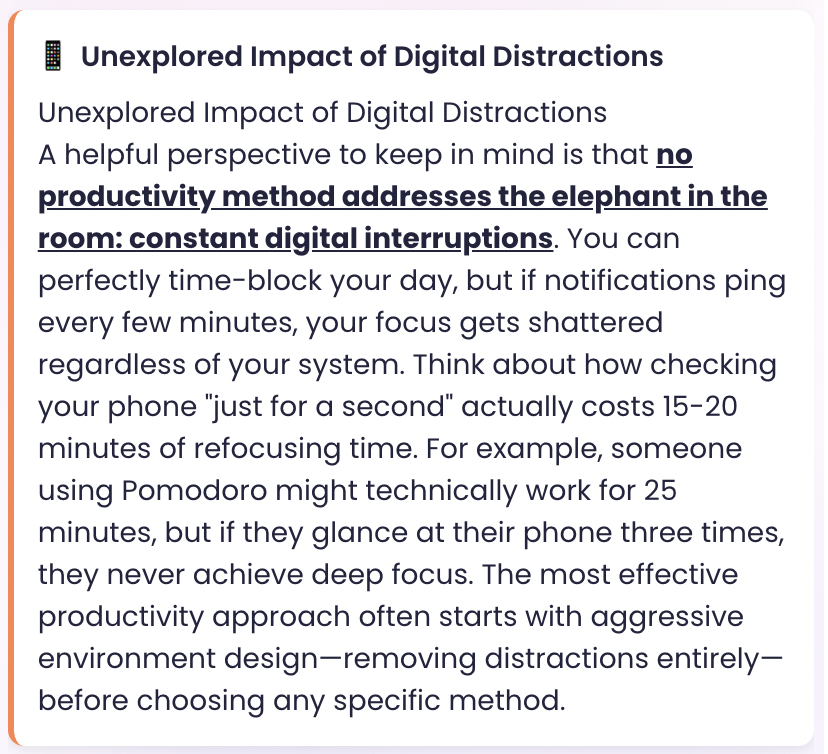
|
The AI frames productivity as a choice between competing methods. Critique reveals that the environment is a more powerful factor that can invalidate any method. Without this, you would blame the system ('Pomodoro isn't working for me') when the real culprit is your notification settings. This insight stops you from endlessly swapping methods and forces you to solve the root cause of distraction first. |
See what just happened?
With one click, you went from a superficial, "balanced" view to a deep, nuanced understanding.
You started with a simple list of tactics. You ended with a smarter way to think about your own productivity—considering your personality, energy levels, work environment, and the true meaning of "effective" work.
Stop Building Your Knowledge on Quicksand
When an AI answer sounds complete, your brain stops questioning. That’s how you build false confidence.
Don't settle for the illusion of completeness. Use Critique to see the full picture.
Try Mnemosphere and discover what every AI answer isn't telling you.
